foundations
- Progress: Done
Overview
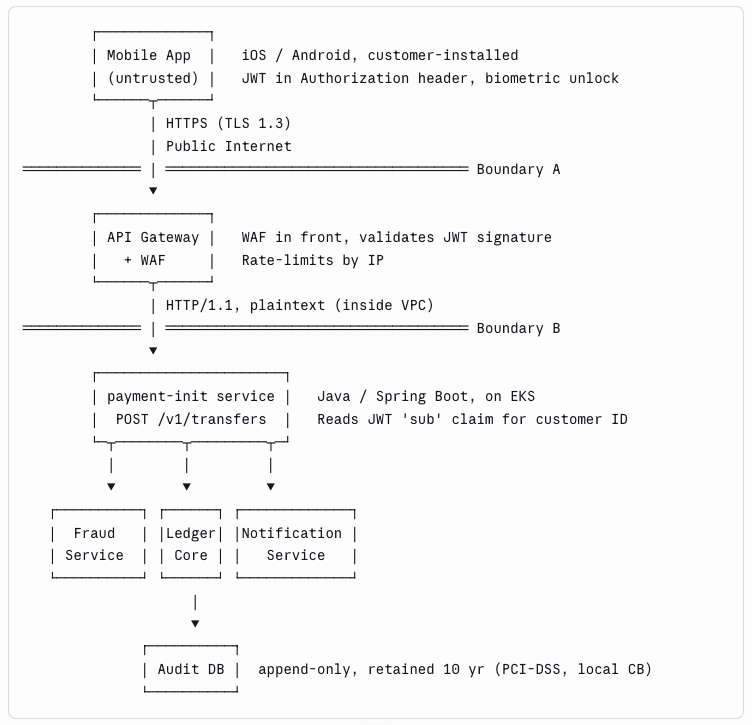
Mobile app request body
POST /v1/transfers HTTP/1.1
Authorization: Bearer eyJhbGciOiJSUzI1NiIs...
Content-Type: application/json

{
  "source_account":      "VN0123456789",
  "destination_account": "VN9876543210",
  "amount":              { "value": 5000000, "currency": "VND" },
  "memo":                "Rent November"
}
Concepts
Security
- Confidentiality: Data is only readable by authorized parties
- Broken by: Eavesdropping, data leaks, etc.
- Integrity: Data is not modified without authorization, and modifications are detectable
- Broken by: Tampering in transit, SQLi
- Availability: System is usable when needed
- Broken by: DDoS, ransomware, etc.
Flow
- Authentication: Prove who (or what) is making the request
- Authorization: Decide what that identity is allowed to do
- Accounting / Audit: Record what was done by whom and when
Best practices
- Rule: Data crossing trust boundaries must be re-authenticated, re-authorized, re-validated, encoded, and logged
Categories
| Letter | Threat | Violates | Example on QuickPayS |
|---|---|---|---|
| S | Spoofing | Authentication | Stolen JWT → attacker impersonates a customer |
| T | Tampering | Integrity | MITM rewrites destination_account in transit |
| R | Repudiation | Non-repudiation | Customer claims "I never authorized that transfer" — can you prove they did? |
| I | Information disclosure | Confidentiality | Error message leaks "account VN98… does not exist" (account enumeration) |
| D | Denial of Service | Availability | Flood /v1/transfers with bad-signature requests to exhaust CPU |
| E | Elevation of Privilege | Authorization | The red team finding above — acting on someone else's account |
Approaches
- Attack tree: Decomposes target objective into sub-goals
- Root: Attacker's objective
- Children: Ways to achieve it (OR nodes by default; AND nodes require all children)
GOAL: Steal funds from customer Y's account via QuickPay
├── OR: Compromise customer Y directly
│   ├── Phish credentials + bypass MFA
│   ├── SIM-swap to intercept SMS OTP    [cheap, high yield in retail banking]
│   └── Malware on Y's phone
├── OR: Compromise the API surface
│   ├── Steal/replay a valid JWT
│   ├── Find IDOR/BOLA on /v1/transfers  ← red-team finding
│   └── Bypass WAF and inject
├── OR: Compromise an insider
│   ├── Bribe a back-office operator
│   └── Compromise a CI/CD pipeline that can push code
└── OR: Compromise the rails
    └── Manipulate destination at clearing layer (out of scope here)